
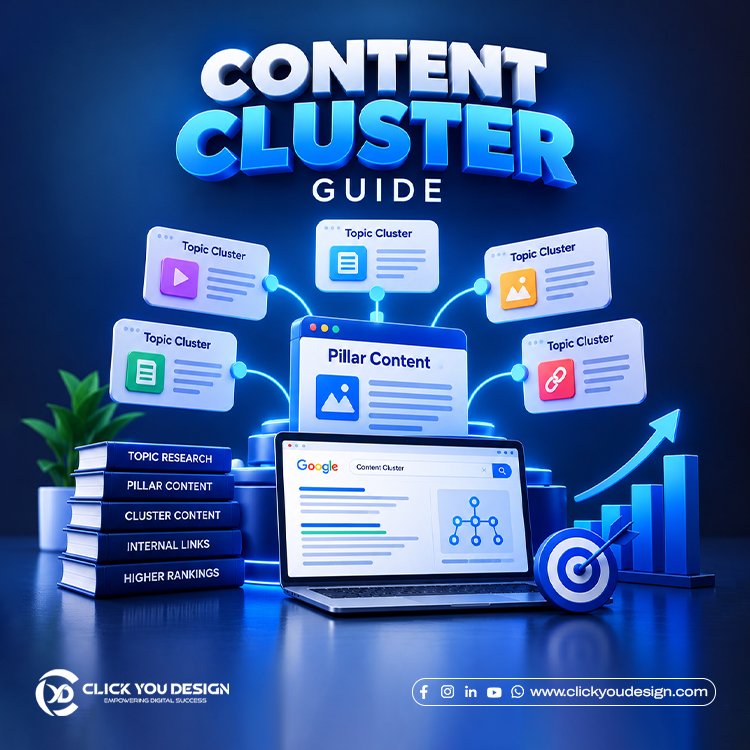
The content cluster guide explores how to build better website content by organizing and placing it strategically. Content clustering is one of the main strategies for improving SEO rankings. Instead of selecting random topics, businesses should create content around relevant topics and connect related pages. Otherwise, Google and AI platforms may struggle to understand your services and topics, which can create gaps between your pages. Therefore, this content cluster guide explains how to structure your content effectively and build stronger topical authority.
What is a content cluster?
A content cluster is also referred to as a topic cluster. A content cluster consists of interconnected pages, with a main pillar page that deals with the core topic. The subtopics connected to the core topic are also linked through hyperlinks on supporting pages. The pillar page navigates to the subpages, and the subpages navigate back to the original pillar page.
For example, if your main subject is digital marketing, it would be considered the pillar page. SMM, SEO, website design, and other related topics come under the subpages and connect to the pillar page through interlinks.
Advantages of Content Clusters
Content cluster strategies offer many benefits in the AI era. They help Google and AI platforms like ChatGPT, Gemini, and Claude recognize the topics covered on your website. Moreover, topic clusters help you build content authority, which can enhance your visibility across search engines and AI platforms.
The main advantages are listed below:
- Create authority for your content to compete with more keywords
- Help to bring out query fan out
- Effective cite structure
- Strengthen internal linking
- Connect related topics
- Improve user experience
- Increase organic traffic
Process of creating a content cluster
Creating a content cluster guide is important for webpage organization as well as SEO. Addressing a topic through user queries on AI platforms and other search engines can indicate the success of a content cluster.
For example, people may search, “Best digital marketing agency offering comprehensive services at an affordable price with long-term commitment.” This query can have several query fan-outs, such as “best digital marketing agency,” “digital marketing agency with comprehensive services,” and “digital marketing agency offering affordable prices.”
AI platforms may analyze these related questions and provide answers based on relevant information across your website. When your pillar page answers these questions and connects to relevant subpages, it helps organize the topic and its related information effectively.
Therefore, when selecting a topic, carefully consider the following:
- Find relevant topics
- Research and brainstorm ideas around the topic
- Find the right keywords
- Structure the topic and related subtopics
- Create relevant content for the pillar topic and subpages
Conclusion
A content cluster guide provides an informative strategy for content writers and website designers. It plays a key role in enhancing visibility and supporting organic growth. Without proper planning, choosing content for your site can become unorganized and may create disconnected pages that make it harder for search engines to understand your website.
Therefore, create a content cluster guide and put it into practice to build a well-structured and connected website. This approach can help improve your website’s visibility and support better search engine rankings.
At Click You Design, we create effective content marketing strategies that support your website SEO and online growth. Connect with us to build a structured content strategy for your website.