
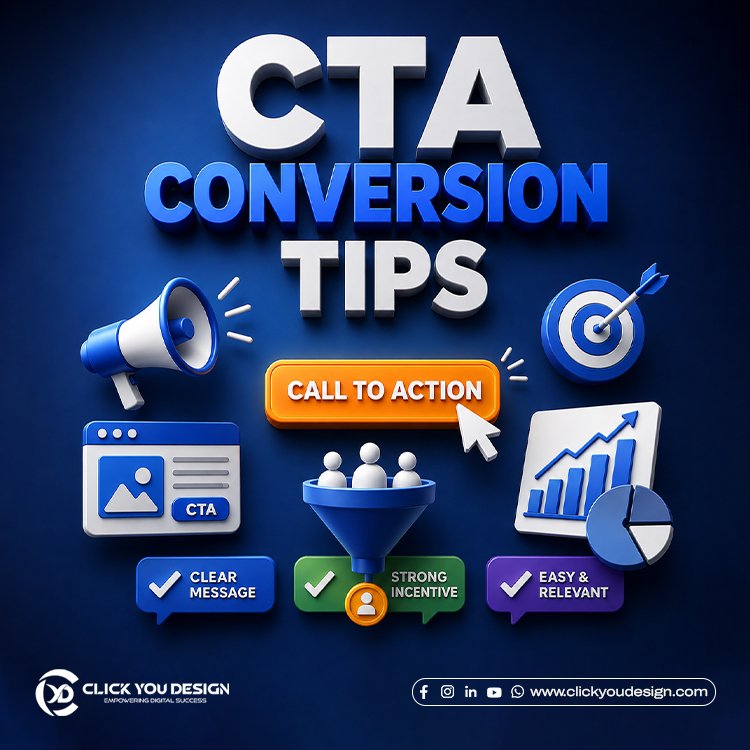
CTA conversion tips help businesses create effective call-to-action that encourage audiences to take the right action. In this blog, we discuss how powerful CTAs improve customer engagement and drive better results.
A call-to-action is an essential part of business newsletters, websites, social media posts, flyers, and video reels because it guides customers toward the next step. Without a clear CTA, even well-designed marketing content may fail to attract attention and generate conversions. Therefore, businesses need strong call-to-action strategies to connect with their audience and turn interest into action.
At Click You Design, we focus on creating effective CTAs that help businesses achieve their goals and attract potential customers. With our experience in digital marketing, we explain what makes a powerful call-to-action and share valuable CTA conversion tips to help businesses improve their marketing performance.
What is a call to action (CTA)?
A call-to-action (CTA) is a creative brief that encourages visitors or scrollers to take action, such as contacting a business, exploring services, or making a purchase. CTAs mainly appear on websites, blogs, social media posters, emails, advertisements, and other marketing platforms to guide audiences toward the next step.
For example, while building a landing page, businesses consider the CTA one of the most important elements because it directly influences customer actions. Therefore, strategically placing a CTA in a visually appealing banner or a dedicated section helps attract attention and encourages customers to experience the products or services a business offers.
CTA Optimisation Tips: Create Powerful CTAs That Drive Conversions
1) Research Your Target Audience
Understanding your target audience and analyzing their needs is the first and most important step toward creating an effective call-to-action. A successful CTA should match your audience’s interests, expectations, and the type of business you represent.
For example, if you run an interior design firm, your CTA should encourage customers with messages like “Get Your Free Consultation.” Similarly, if you are in the medical field, CTAs such as “Book Your Appointment Now” or “Schedule Your Consultation” help guide patients toward taking the next step.
Moreover, if you are a website developer, your CTA should focus on encouraging potential clients to connect with your services through options like “Contact Us Today.” When targeting a younger audience, such as teenagers in their 20s, action-driven CTAs like “Join Now” can create better engagement.
Therefore, understanding your audience and aligning your CTA with your business goals plays a major role in creating effective call-to-actions that generate better responses.
2) Analyse Competitor CTAs to Improve Your Strategy
Before creating a call-to-action for your ads, website, or social media content, analyse the CTAs your competitors use. Instead of copying their content, study their wording, messaging, and strategies to understand what attracts their audience. Then, use those insights to create a more engaging and unique CTA that reflects your brand.
Moreover, choose language that sounds polite, friendly, and persuasive rather than demanding or aggressive. A well-written CTA encourages users to take action without making them feel pressured. Finally, place your CTA in a highly visible banner or use attractive colours to make it stand out and capture your audience’s attention.
3) Start Your CTA with Action Verbs
The main purpose of a call-to-action is to turn visitors into customers. Therefore, motivating users to take the next step is essential for improving engagement and conversions. Using strong action verbs makes your CTA more compelling and encourages your audience to click, explore, subscribe, or make a purchase.
Moreover, action-orientated CTA buttons such as “Learn More”, “Contact Us”, and “Get Started” guide users toward a specific action and encourage them to interact with your website or marketing content.
Use action verbs such as:
- Join Now
- Apply Now
- Subscribe
- Book Now
- Get Your Free Quote
- Consult Us
- Download Now
4) Use Emotional Triggers in Your CTA
A call-to-action should encourage people to experience your products or services by creating interest rather than forcing them to take action. Therefore, using emotionally engaging and persuasive CTAs helps attract more customers.
For example, most shopping apps include an “Add to Cart” button that encourages users to continue their purchase. This simple CTA creates interest and makes the buying process easier. On the other hand, if a website does not provide clear action buttons or a smooth purchasing experience, visitors may leave the page and choose another website that offers better convenience.
Therefore, create CTAs that naturally motivate users to take the next step. Instead of using forceful language, use persuasive and customer-friendly messages that encourage action while providing a positive user experience.
Conclusion
A call-to-action should stand out and attract customers to take action that supports your business growth. In this blog, we explore four effective CTA conversion tips that can help marketers improve their content and achieve better results.
Moreover, these strategies can make your CTAs more engaging, persuasive, and conversion-focused. At Click You Design, we follow these proven practices to create effective call-to-actions as part of our content marketing strategy.
With our expertise in content marketing and digital marketing, we help businesses create compelling content that drives customer engagement and conversions. Explore our services to learn more about Click You Design and discover how we can support your digital marketing requirements. Contact us today to get started.